

How to Create Jewish Joy and Pride
A Talk with Rabbi Rebecca Blady about Hillel and Jewish resilience
“And yet, for the Jewish people, we have celebrated our ‘Resilience’ since the beginning of time. Our traditions emerged from a forty-year trek in the desert, preceded by a walk through a sea. Our Torah tells a story of a vastly imperfect people and a singular God who struggles to understand them – and, despite all this, the people and God build a relationship, an expansive one that evolvers in character and adapts to countless situations, threats, and surprises.” (Rebecca Blady, The Jewish Pursuit of Justice at the Festival of Resilience, in: Micha Brumlik / Marina Chernivsky / Max Czollek / Hannah Peaceman / Anna Shapiro / Lea Wohl von Haselberg, “NACHHALLE”, Berlin, Neofelis, 2023.)
Rabbi Rebecca Blady is Chief Executive Officer of Hillel Deutschland. She was born in Brooklyn and moved to Berlin with her husband, Rabbi Jeremy Borovitz. They founded Hillel Deutschland, the German section of Hillel International. Hillel is a Jewish non-profit organization with the impact of Jewish joy and pride, offering a safe space to young Jewish people who want to learn more about Jewish identity, their life, their work, their future and to prepare for leadership. In the last years, Hillel has created a large network across Germany, collaborating systematically with Jewish institutions and other civil society organizations.
On October, 9th, 2019, Rebecca and Jeremy came from Berlin to Halle to participate in the services of Yom Kippur 5779 in the synagogue of Halle (Sachsen-Anhalt). One year later, they founded the Festival of Resilience. Now, they work together with other organizations to create solidarity in remembrance culture on the Shoah and on recent racist, antisemitic and xenophobic incidents across Germany. From now on, the work of the Festival of Resilience will be continued under the roofs of Widen the Circle.
From Brooklyn to Berlin
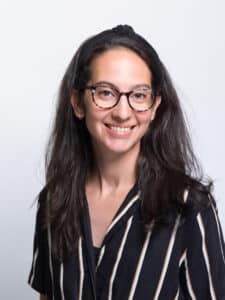
Rabbi Rebecca Blady Foto: Max Mordinson.
Norbert Reichel: How did you become what you are today?
Rebecca Blady: In university, I studied journalism and politics. I always thought that I was going to the field of communications, journalism, possibly non-profit communication, something that had a touch to it. When I was working in the field, actually in a small film production company, I found myself wanting to be not behind of the camera asking questions and editing the answers than rather to be with the people doing work on some of the important causes we were featuring in these films.
So, I chose to leave that. In the back of my mind I have always thought going more in the direction of orthodox feminism. In New York, I grew up orthodox. At some point in high school, I found out about a movement, the Jewish Orthodox Feminist Alliance. I remember writing an article for their magazine and I found out that there were other people like me who wanted to find more space for women in the religious community. And at the time I was leaving my job and was thinking about what to do next, I thought you know what, why not now!
I will go and try to find my way into a leadership position where I can serve the Jewish people and serve God. And that brought me to Yeshivat Maharat which is the first institution in the United States to give rabbinic ordination to orthodox women. I studied there for four years, from 2015 to 2019, and I received ordination in 2019.
Norbert Reichel: About seven years from now. But during this time you moved from Brooklyn to Berlin.
Rebecca Blady: Another aspect of my identity in the development of the time, I come from a family of all Holocaust survivors. My two grandfathers were from Poland and my two grandmothers were from Czechoslovakia. At some points, also in my university years, I started to wonder what would have happened, if they hadn’t been so lucky to find their way to the United States. In the United States, especially in New York, I was able to grow up with a very rich and a very strong connection to Jewish community and to Jewish tradition. You know, I wondered, perhaps, if they survived the war and had not succeeded in finding ways to immigrate across the Atlantic, then I would probably be living in a Central or Eastern European country without the same access to a Jewish community and Jewish learning.
I actually met my husband Jeremy in 2012 and we married in 2016. My husband and I, we bonded over these matters. He was a peace corps volunteer in a small village in Ukraine and from there he moved to Kyiv and started working with the Jewish community. Around that time, our pasts crossed and we had a very meaningful conversation about what we wanted to do with our lives. And that was to share something of ourselves with these communities in Eastern and Central Europe to enrich their learning, to bring them more access to Jewish tradition and Jewish text and to really foster sense of community in this part of the world. For me it was very much connected to my heritage, to my grandparents who did not get to have this opportunity. You know, for my husband, it was very much a calling as well, for different reasons. That brought us here. We felt that we could be more of service here than in New York.
Hillel Deutschland – Working for a sustainable Jewish future
Norbert Reichel: And now, the place of this service is Hillel Deutschland.
Rebecca Blady: Exactly. We first arrived for one month in 2016 and we opened a small project. We had a very small amount of funding. The project was called Base Berlin. We rented an apartment for one month in a loft building in Kreuzberg. We just hosted Shabbat meals and Jewish learning, different events that brought together a pluralistic cross section of the Jewish community, people who would never have met each other. We said explicitly, this is the place where you can be yourself and Jewish.
That was the beginning of all that. We came back for a second summer, seeing that we were successful again and we opened Base Berlin again, for two months. Then we returned to the US and we understood that there is a need here in Berlin. We weren’t even thinking about all of Germany. We saw that there is a need in Berlin for a kind of Jewish space that focused on relationship, that focused on Jewish contents, and that we really lived a value of pluralism in a sense that we have a plurality of Jewish identities welcome in this space.
So, we decided after this successful summer that we would move to Germany and – you know – we thought we would come for two or three years, but at the end what was happening was that we founded Hillel Deutschland. We had an investment from Hillel International, which is one of the largest movements for Jewish students in the world, based in the US. We were fortunate to have commitments from two other foundations. We started building what then became Hillel. We tested out many different projects. We were still living in an apartment inviting people there to experiences. We did not have a separate space. But all of this was very special. We were able to really create something, to create a new kind of Jewish space, where people felt that they belonged, and to grow it, gradually, to build partnerships with other stakeholders in the community, the Jewish institutions in Germany.
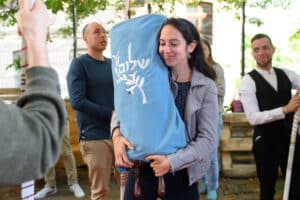
Rebecca Blady at a Thora dedication ceremony at Hillel, private photo.
That was the beginning of what Hillel eventually became. It is an organization, “ein eingetragener Verein”, that works to bring together Jewish students and young adults from all over Germany for purposes of community building, learning and empowerment.
Norbert Reichel: Is there a difference between working for Hillel in New York and working for Hillel in Germany?
Rebecca Blady: Yes. There is a difference how Hillel works in Germany and how Hillel works in the US or in other countries. In North America, Hillel operates on college campuses, because that’s how young adult life in the US is most organized for the most part. There, many young adults take their first steps out of their homes where they grow up and go to university campus, where they are beginning their identity formation. Here, in Germany, we don’t commit working for one campus, we work nationally and regionally. Our headquarters are here in Berlin. We have five other regions in the moment, Munich, Stuttgart, Frankfurt am Main, Bremen and Leipzig. So, we are creating spaces where Jewish young adults from across Germany are welcome to come. Hillel in Germany becomes a third space for these people. It is something else, outside their home, outside their work place, outside their studying place. This is a place where they can come and create community for themselves.
Norbert Reichel: What kind of relationship do you have with the Jewish institutions in Germany? Is there a connection?
Rebecca Blady: Absolutely. One of the first directives that we received from a variety of stakeholders was that whatever we build it has to become sustainable. It had to have the capacity to outlive me and Jeremy. And the way how this sustainability can be achieved is by working with the established institutions in Germany.
We have built quite a strong relationship to the Zentralrat der Juden in Deutschland. We have been cooperating in several projects, the most important one until now being the Engagement Internship which actually enables us to create relationships directly with different Jüdische Gemeinden across Germany. So we provide professional training, event ideas, mentorship and the community benefits by having young adult activities. This is one example how we work with Jewish communities with the support of Zentralrat.
But I also have to say that security is a big topic, since October 7th an even bigger one. The Zentralrat actually is supporting us with significant funds to enable us to secure our Berlin headquarters. It’s really been a gamechanger for how we feel comfortable in operating in our own space. It took time to get the funds, to build the necessary infrastructure, but the process is basically complete now. I am very grateful for that we could benefit this way. This would not have been possible without the partnership of the Zentralrat. We have also a strong partnership with the ZWST (Zentralwohlfahrtsstelle der Juden in Deutschland). Every year we have a precence at the Jugendkongress and we do some kind of the educational activity as Hillel. We also try to support their young adult programs as much as we can.
It is very much important to us that we don’t operate in a vacuum. We don’t operate in a separate structure; we are trying to build an inclusive structure. That is an extremely foundational principle to us. We should be inclusive; we should be pluralistic. You know, the Jewish communities have certain limitations, right now, regarding for example inclusion of patrilinear Jews or people who are not Mitglieder of the Jüdische Gemeinden or used to be member of Jüdische Gemeinden, but for some reasons, they lost track of it. We do actively welcome people like that. This is really important. But we also see that there is great value in working with the structures, that we can bring the entire community gradually into the future.
Norbert Reichel: You are working in schools and universities, too?
Rebecca Blady: We occasionally hold events on university campuses. We don’t have official structural partnerships with universities. Schools are not our target. It would be nice, because I think that it is a target group younger than our target group, but we have not focused on it yet. Our target group is between 18 and 35.
Engagement Internship
Norbert Reichel: Let’s talk about an example of your work, why not about your favorite program.
Rebecca Blady: I would say, the Engagement Internship is for sure my favorite program. I had the idea to adapt this program which was actually developed by Hillel in the US. And I thought why not adapt this for Germany? It meets all our goals. It is an empowerment program for young Jewish leaders. It contributes to sustainability of Jewish communities. And we don’t need a campus to do it. You know it is something to build it as a pipeline to Jewish professionalism in the long term.
That is the way it works: We partner with a Jewish community or student union in a particular region. Together we decide to open an internship, we work together to select the intern who should be living in the particular region. The first several months of their engagement are just about them building for that work. They spend about five to ten hours a week just talking with people, going for coffee, understanding the basic needs of Jewish students in their region. In the second part of the year, they work with the Hillel mentor to create programs, events to bring together the students based on their needs. What I really like about the events that come out of it we place a strong emphasis on partnerships and collaborations. We tell all the interns that we are not there to be in competition, we are not a capitalist entertainer. We don’t need to take all of the students for ourselves because in fact the more places a young Jew feels comfortable it is better for everyone. We had some really interesting partnerships and projects emerged from the internship program. I think it has enormous potential to carry the community forward.
Norbert Reichel: You understand yourself as a feminist. Where is the feminist impact in this program?
Rebecca Blady: The value of advancing women, but also non binary, trans and queer people, is something that comes across. There is no particular feminist program. It is the value of inclusion. Inclusion is never perfect. We as an organization still have a lot to learn. I would say, probably, one of the reasons to have so many different projects, so many different events, going on in any given month or year, is that we know that not everyone will hundred percent feel comfortable with every single event.
But I do think one of the main ways that that desire for greater inclusion and advancement comes through is in basically our commitment to making Jewish learning more accessible, especially for historically underrepresented groups in the context of Jewish learning, like women, queer people, who do not have access to yeshivas or learning at a high level. When we do run programs, we try to really lead with Jewish contents for these reasons, also, by the way, not only speaking of gender, but of many people in the community who grew up in a post-soviet context. There are people who know they are Jewish but they are not able to practice Judaism and they were not able to teach their children what it meant to live Jewish life. Very often, we see that the children are teaching the parents. Somehow, we have participants, who grew up in this post-soviet context, not all of them, but many of them are coming to learn about Judaism for the first time, and they take it home, and that is also a really beautiful thing.
I think, my instinct for feminism is not only feminism, it is also just generally towards the advancement of people who have not the position or access.
The Festival of Resilience – towards a sustainable future of remembrance
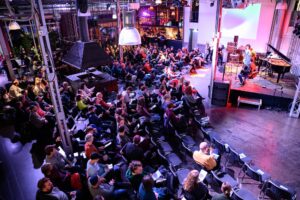
Festival of Resilience 2024, Foto: Max Mordinson.
Norbert Reichel: You are one of the organizers of the Festival of Resilience. You created it with some of your colleagues and friends after the attack on the synagogue in Halle on October, 9th, 2019, Yom Kippur 5779.
Rebecca Blady: I have to tell you I am actually very happy to talk about it today, because we just had a recent development of the festival which I think is very much part of the story and which I want to share with you. But first, I can frame a little bit what the festival is about.
The Festival of Resilience was a project which started in 2020. The main people who created the festival together were Jewish survivors of the antisemitic, racist and xenophobic attack in Halle and Wiedersdorf, in 2019. We were working with a part of the group that went from Berlin to Halle to bring some spirit on Yom Kippur to a small congregation on a day that has real enormous potential for holiness and joy. You know what happened. The day was extremely dramatic for a lot of people. And the more it created the opportunity for different parts of German society to try and create a narrative out of it. That was October 2019.
In the summer of 2020, there became the trial against the perpetrator. As a result of the trial but also because – you know – an attack on a synagogue is significant given German history. We understood, there were politicians, journalists, lawyers who would all create their own narratives and try to use the survivors as instrument proving their narrative.
But we don’t want that. We want our own narrative. So, we would do something for the first anniversary after the attack. The Jewish anniversary! Not October 9th but Yom Kippur! We wanted to come together and to do something meaningful. Last year, Yom Kippur was very terrible, but Yom Kippur was supposed to be a very holy time, a very joyous time, and because of what happened on Yom Kippur, we didn’t achieve this holiness and we certainly didn’t achieve the joyous succors. So, we decided to create the Festival of Resilience; we had services on Yom Kippur, something that was organized by Hillel. We still to this day have services on Yom Kippur, because creating that space was a very testimony of resilience when someone tries to take that space to create something new where people feel comfortable.
The focal point was the ceremony of resilience. It was open to everyone. We wanted people to come and we wanted to present something that we created. We also felt given what had happened last year it was important to invite the survivors and loved ones of those who were killed on February, 19th, 2020, in Hanau, because we also understood that times were changing not only for Jewish people but also for several minority groups who were under attack by this horrible ideology.
We built this festival as a means to create solidarity as a contribution by the Jewish community to build bridges to other people who are in similar vulnerable positions. We didn’t do this as a standard remembrance event as an instrument for all of the people I mentioned earlier, we wanted to do something that really focused on joint celebration and life. That was the basis of the Festival of Resilience. Every year, since 2020 we had held a Festival of Resilience. The purpose of the ceremony of resilience is really to feature survivors. You know, survivors of the 9th of October were not always automatically ready to contribute. They had to go to their own processes of their own healing. So, over the years, we were able to open the stage to different survivors in different times so that they were ready. It is an opportunity for testimony. But also, every year, we have a cultural contribution. We’re bringing music, we’re bringing arts. In 2025, we had an exhibition honoring the past five years of the festival with all different installations and live art as well. So, there is always something that is designed to move people in the way that they can access to really understand that resilience is a Jewish thing. We don’t just remember; we try to relive, meaning, we try to get in touch with the direction we would like to go, as a result of the original thing that happened.
Norbert Reichel: I would like to add that it’s just as so many survivors from the Nova festival in Re’im and their families and friends were proposing: “We will dance again!” In 2026, you established a new partnership to guarantee the sustainability of the Festival of Resilience.
Rebecca Blady: What is going on now with the festival is very interesting and it is a story I want to tell. Over the years, even as different survivors has been able to come forward and share what this time means to them, a lot of survivors have become very tired. And as a matter of fact, it is a lot to ask survivors to continue to be the co-designers of an event that kicks up something dramatic that happened. We also built an incredible volunteer team for this festival. Together with the survivors and the volunteers we established something that is about to change. We have been shaping this thing for a very long time with a lot of effort bringing together people from many different communities. This is really extraordinary. But something has to change because people are losing their energy.
So, we decided rather than close the festival to a lack of capacity to start conversations with different and particular contacts with another organization called Widen the Circle. They are a non-profit organization. They have a tremendous network of practitioners in remembrance culture all across Germany. Its majority are actually non-Jewish people who work to keep the memory of the Shoah alive and relevant. They also have many practitioners who are specialized in remembering also racist incidents and contemporary antisemitic incidents that happened in Germany recently. They fight for a more just society. They also have conferences and forums that bring together memory practitioners from the United States who work on remembrance culture on slavery. So you have already the values of remembrance, you have solidarity and finally, you have the value of the Jewish contribution. The organization started in connection to the Obermayer Foundation, a Jewish contribution to the memory work on the Shoah.
After a lot of conservations, we shifted the project of the Festival of Resilience to Widen the Circle. The Festival of Resilience continues to exist. I continue to advise the festival. The volunteers are still engaged. But now it shifts to a new organization. I hope, it will be an interesting kind of success story, it will be a way to take the project from one non-profit to another, so that it receives new life and new energy. I think, we could agree that the project is important and I feel that it is for the German society and also for the field of memory work. So, there is no reason that it should close because of lack of capacity and interest, but we have to be creative about how we think to carry on. I am very proud of that development and I am excited to see what this development will bring in the future.
Changes after October, 7th
Norbert Reichel: And we see how important it is to keep projects like this alive, especially after October 7th. We don’t need to add the year to this day, it is always very clear what we are talking about remembering this date. I dare to say: Nearly everything that was happening in the following years until now may be considered as a result of October 7th. Anastassia Pletoukhina called October 7th ten months later in our interview an always enduring day. One Year later, Tamara Or said nearly the same, October 2023 is never ending. (in: Alles hat seine Zeit – Von der Gleichzeitigkeit im Judentum, in: Zeit im jüdischen Kontext, hg. von Gisela Dachs im Auftrag des Leo Baeck Instituts Jerusalem, Berlin, Suhrkamp Verlag / Jüdischer Verlag, 2025). Did your work change after October 7th?
Rebecca Blady: I would certainly say that our work of course changed. First of all there is a short term. Now we are in a medium term. I don’t know what the long term holds.
Norbert Reichel: Nobody knows.
Rebecca Blady: Nobody knows. In the short term, I would say, people do not feel safe anymore. It was instantly clear that this attack from Hamas was also a sign, a signal to people all around the world that it is okay attacking Jews again. I think, it was hard to explain to people. But you know, as Jews living in the diaspora, we saw that antisemitic incidents always existed, but people were feeling okay, because we had many partners in all different areas, in the cities, in the communities and in civil society. But from October 7th, ,we gradually didn’t see this happen; we missed the partnerships we thought we had before. So, people are very scared.
To this day, one of the medium-term effects of October 7th is that a lot of the students, the young adults who come to Hillel do actually not disclose their Jewish identity on their campuses or in their jobs. They don’t feel comfortable with this. We had to shift how we talk about what we do. We at Hillel have always been a space where we want as many different kinds of Jewish people to belong. In the past we did use language of Jewish pride. We want people to belong so that they can cultivate a sense of Jewish pride in their Jewish identity.
Being proud of one’s Jewish identity is still possible today, but it is more complicated, because people are not sure what they would like to show their Jewish identity. So now we talk a lot about a place to belong and a place to feel safe. And we talk also about a place to rediscover one’s courage. I think people have felt a lot of anxiety since October 7th. This is only natural given the direction that is taken to be a Jew in the diaspora. When you see how many have had violent attacks, it is not surprising any more, it is something that you can lose all sense, because it’s becoming so frequent. I think, people just understand that this is a new reality where nothing is guaranteed. A safe space is not guaranteed, although Hillel is trying to be that safe space. We always want people to come to Hillel, we want them to feel comfortable, to meet people. We also want them to think.
And that hasn’t changed. So, still after October 7th, priority number one is making sure that people are feeling safe in a Jewish space. In addition to that we want people to continue to be interested in learning and to find courage to think about the difficult topics that have arisen since October 7th. It is very important to Hillel, we see ourselves not only as a Jewish organization but as a civil society organization. We do not run in a vaccuum.
We have a certain project, a project called the Hillel Leadership Incubator. And we very much believe in the product of this incubator every year, in which we train a cohort of ten young Jewish people to become a leader. We always say: You should be a leader, perhaps in a Jewish community, but it would also be wonderful if you take up leadership in civil society and you do this as a Jew, with your Jewish values. That continues very much to be the case. And in this thing, we also have done a lot in cultural dialogue, in religious dialogue in the last year. We built partnerships with different communities of people with Iranian background, the Muslim community as well. We have a lot of good relationships, but not all relationships have that ability that we would like them to, given the ongoing world situation. But we don’t stop trying and we continue to pry for that we are still part of German civil society. And even knowing what that means and how comfortable we feel, what has changed, it’s still the reality.
So, we have to continue to think how we can make Jewish people contribute to German civil society, how we can be active, how we can bring our whole society forward.
Creating a space of discussion
Norbert Reichel: A lot of your target group are children of Jewish immigrants from the former Soviet Union. How do they feel after October 7th and – we have to consider this, too – after February 24th, 2022?
Rebecca Blady: In Hillel Deutschland, we have always taken the belief that Israel is a vital sanctuary for Jewish life, worldwide, and that we believe in Israel as a democratic state that embraces all the people who live there including the rights of the minorities. After October 7th, I saw how really important it is that we define Israel as an important sanctuary for Jewish people.
When we think about our post-soviet target group, children of Jewish immigrants from the former Soviet Union, I hear this all the time that for the last several generations they cannot remember when a child was born in the same country as their parents. And so, all of them have this narrative of displacement. And I would say that this really actually started to be clear for me on 2022, February 24th, when Russia began its full-scale attack on Ukraine and we felt completely shaken. We know how important this region is for our people. 45 percent of the Jewish people have their family there.
So then with October 7th, you have another crazy shake-up, because this region of Belarus, Russia and Ukraine is no longer a stable place that has a feeling of home to these people, and Israel which has always supposed to be a sanctuary for Jewish people is also under attack and also cannot be regarded as safe in the same way as it was before. This is very complicated for this target group that in the course of two years two places that had been in their mind a sort of imaginative home had been taken away completely.
Now people think about Germany: Is Germany a home? Interesting. Right. It is an interesting question. We live here. You know, we do experience increasing amounts of minor or major discrimination of people for being Jewish, like people who are speaking Hebrew in public places. Things like that happen. We fear around disclosing our full self in public. Some have more fear than others, for all have different comfort levels. But now we have to think: What is the future here for young Jews, because the sense of potential homes for young Jews is declining? So also, a part of the work that we do, at least being a German organization, is to work with these people and trying to explore the way that Germany can be a home, that people can find a sense of community, that people can learn enough about their Jewish identity to build their own Jewish structures, their own Jewish homes here.
Maybe, not everyone will choose to live here in a long term, but I will say, in the last few years, we had a lot of people come from Ukraine, a lot of people come from Israel. It’s shaped what it means to build community among young Jews in Germany, because it is more international, there are more stories of displacement than ever before. And what it means to create a community, also changed, because you have to take in account the way people feel about home, the way people feel about permanence, the way people feel about Germany. It is all very complicated. And we do the best that we can.
Norbert Reichel: A lot of questions!
Rebecca Blady: A lot of questions. Yes. And I think that it is also a part to be Hillel is actually to raise the questions, because people sometimes have these questions but do not raise them. They live inside. But we want to create a space where it is okay to raise this kind of questions. It is very likely: You are not alone in wondering these things. So, we want to be a space of discussion, of active thought, of critical thinking in all these things.
Reading more:
- Eugen El, „Gemeinsam sind wir stärker“ – Rebecca Blady über das „Festival of Resilience“ mit jüdischen und nicht-jüdischen Halle-Überlebenden, in: Jüdische Allgemeine, 23. September 2021.
- Esther Dischereit, Hg., Hab keine Angst, erzähl alles! Das Attentat von Halle und die Stimmen der Überlebenden, Freiburg im Breisgau, Herder, 2021, auch erhältlich über die Landeszentralen für politische Bildung, darin unter anderem: Rebecca Blady und Jeremy Borowitz, Gegen „sündhaftes“ Verhalten protestieren, wo immer es möglich ist.
- Joshua Shultheis, Nah bei Gott – Rebecca Blady ist orthodoxe Rabbinerin und versteht sich feministisch, in: Jüdische Allgemeine 6. März 2022.
- Norbert Reichel, Die Büchse der Pandora – Anastassia Pletoukhina über zehn Monate 7. Oktober, in: Demokratischer Salon, Juli 2024.
- Jeremy Borovitz, Von dem Mann, der uns nach dem Anschlag Bier brachte, in: Jüdische Allgemeine 9. Oktober 2024.
- Norbert Reichel, Wir werden wieder tanzen – werden wir? Jüdische Stimmen nach dem 7. Oktober, in: Demokratischer Salon, Oktober 2024.
- Zeit im jüdischen Kontext, herausgegeben von Gisela Dachs im Auftrag des Leo Baeck Instituts Jerusalem, Berlin, Suhrkamp Verlag / Jüdischer Verlag, 2025.
- Mascha Malburg, „Der Attentäter ist mir egal. Das ist eine Sache zwischen mir und Gott“ – Interview mit Rabbiner Jeremy Borovitz, in: Jüdische Allgemeine 18. September 2025.
(Anmerkungen: Erstveröffentlichung im Mai 2026, Internetzugriffe zuletzt am 13. Mai 2026. Titelbild: Hans Peter Schaefer, Synagoge in Görlitz.)