
A Young Israeli Composer in Bonn
Nimrod Rochell about living and studying in Germany and in Israel
Since 2024, the Israeli composer Nimrod Rochell lives in Bonn doing his Master of Music in Composition for Film, Games and Media at Musicube Academy in the heart of Bonn. He was born in 1995 in Maryland (USA), while his parents were studying there music as well. He talks about the different ways of studying music and scoring in Israel and in Germany, about living in Germany and in Israel after October, 7th, and compares everyday life in both countries.
Studying music in Germany
Norbert Reichel: Why are you studying in Bonn?
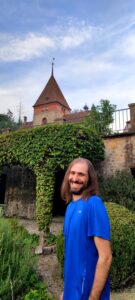
Nimrod Rochell, private photo.
Nimrod Rochell: I studied music for my whole life. I began playing the piano at eight years old. I studied classical piano and switched to jazz piano when I turned 13. Growing up in a musical family, I was very much encouraged or at least not discouraged to presume music. I did my Bachelor’s at the Jerusalem Academy of Music and Dance. I had a small classroom within the university, not outside it, but it felt a bit isolated compared to the other programs, which had more contact with one another (classical performance, composition for media, jazz performance, etc.).
I do have a solid foundation in classical composing, it is my main prisma, but I’m very interested in film as well. The thing is, I don’t want to be only a classical composer. So, I wanted to attempt to reach this area in making music or producing sounds in this big sphere of possibilities you can do with film and music. I was interested in any kind of media, of film and mostly animation. But you need more connections to realize this. There is no place in Israel where you have all the connections you have in Europe or in the US.
So, I was looking for a place where I could study outside of Israel to see a different kind of world and to experience something different, either in the US, either in Europe. I applied to some schools in Europe where I was not successful. Then I found out about a small school here in the surroundings of Bonn. It’s a franchise program run by Musicube Academy in cooperation with Alanus Hochschule für Kunst und Gesellschaft. At the beginning, I thought there is no way I could apply to it because it is most probably in German and I didn’t have time to study the language. I reached out to them and realized that they followed an international approach and the teaching was in English. I applied very quickly while I visited my aunt who have a farm in France. While I was still in Europe, I was accepted. Without knowing anything, I came to Bonn with a Schengen visa and nothing else. Yes, I have to say: It happened to be in Bonn. Last year, I did the preparatory course for my master’s degree. This year, in 2026, I finished the first year of the master and I will finish it in 2027 with the master’s degree.
Norbert Reichel: What are your plans for the time after?
Nimrod Rochell: I would like to try to stay here if I can, to work here. It needs to be on solid feet and you must have a steady job in your own profession. But I am pretty sure.
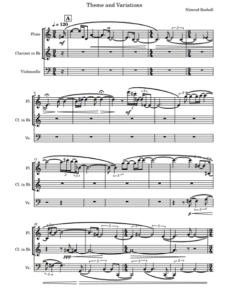
Nimrod Rochell, Kallatina – Theme and Variations, Trio for Flute, Clarinet and Violoncello, first page. © Nimrod Rochell.
Actually, I have a small trio which I was able to write a few months ago. It was played in the summer festival in Bad Godesberg, in a small gallery called Kunstkabinett Stefan Moll. I met Stefan through an exhibition in a different project I worked before. I was introduced to him and he said to me that I could write a piece as part of the festival. So, I wrote a small trio for clarinet, cello and flute. It was performed in the gallery by wonderful students of the Düsseldorf University of Music. It was very great. I could talk so much more about it.
Norbert Reichel: Studying music in Israel, studying in Germany – where are the differences?
Nimrod Rochell: In Germany, school is still subsidized. It is more expensive in Israel than in Europe, but still not in the prices of the US. If you are curious, public universities in Israel cost a little over 3.000 euros for the entire year (I believe around 3.300 euros), which is about 1.650 euros per semester. It is subsidized to 60, 70 percent. It is also getting more expensive every year, about 10, 20, 30 Euros a year. It adds up, slowly but surely.
But first of all, I would say the main difference is the language, some time it would be the approach to communicate in musical terms. It is the system to give every note a name. In German, it is the alphabet – c, d, e and so on, nearly everywhere else it is the Italian way – do, re, mi …. In Germany, they have a specific word for every note: cis, des, dis, es, fis and so on. That is one big difference. In Israel, we have sometimes terminology in Hebrew, sometimes in the German term, sometimes the international way. If you teach musical theory, it is sometimes just different in the terminology, even sometimes in the methods of teaching. In my degree, class is mostly online. They were supposed not to be only online, but with COVID this became the norm, anyway. Well, It is easier and more flexible. In a Bachelor’s you do have many mixed and broad subjects. What I meant is that a Master’s has far fewer courses and is more concentrated, and in some cases and universities the schedule isn’t full-time like a Bachelor’s. That’s why it’s hard to compare them directly.
I don’t feel being an outsider in Germany, I’m feeling getting along. I am very happy being in Germany, for several reasons. But in the German university, they don’t lead you by the hand. No one will hold your hand! This means, you are expected to study, to learn by yourself. In universities in Israel or even in the US, they attempt to feed you more with the end of the spoon. So, it is a bit more strict. That is my feeling how I see the differences.
Norbert Reichel: Would you say that there is more freedom in Germany?
Nimrod Rochell: No, what I am saying is that you might have a kind of more of constructive support if you study in Israel. In Israel, we have a big system of using trainers in university. The professor has an assistant, and many times, you can approach to him to work over the materials, he checks your homework, you always get a lot of feedback. In Germany, you don’t’ always have this tight support.
Norbert Reichel: Do you like the German way?
Nimrod Rochell: Oh, I guess so. I really haven’t decided so far. What I do right now, is a bit more specialized. The thing which I’m missing is some exchange and support while I’m trying to improve my music producing abilities. You study in your lessons, but it is very expected to do your own self exploration. They say, you have a very good base of writing contemporary music in a way. These days, you don’t write your music on a score, you write it in a piece of software, so you essentially produce and write your music in the box, in the computer, in a software environment. Only, if it is very flashed out, you might write in a score and finalize everything. I work a lot on music producing and you have to play with this work tool. You have to open it, you have to experiment, to fail many times, and it takes time. I really enjoy it, but sometimes it is frustrating, sometimes you feel alone. It is not mathematics where you have a definitive answer to show your work. You have a very large plain with a lot of possibilities and it is really big. We all know that in electronic music and in pop music, you can have such a wide ray of combinations. It is limitless. If you study it, you experiment yourself. It takes time and it is a slow progression. But I like it.
Times of war
Norbert Reichel: In Germany, especially since 2023, October 7th, there is an increasing antisemitism. Jewish people, Jewish students are attacked and they are made responsible for the politics of the Israeli government. Being Jewish or being an Israeli citizen has become much more difficult that it has been before.
Nimrod Rochell: It depends from where you are living. I have come to Bonn into a very political and international environment. I can imagine it. But I feel quite secure. I was not attacked personally. I do see a lot of political demonstrations, you can see a lot of different movements according to the actual war situation in Palestine and Israel. But in my case, it boils down to a personal approach. We have a little group of friends, we are very mixed, local people, people from the Middle East, all around, and in all honesty, even with the hardships you’re kind enough. If you’re talking about the subject, you would do better if you do gentle.
Norbert Reichel: This seems to be good news.
Nimrod Rochell: I do think so. I think so, over all, I don’t have any problems, because I don’t have kids who go to school, I think, in a way, I am also sheltered. I heard, it would be trickier in Berlin. I haven’t had the experience. In general, I never felt that I was in any danger. We had sometimes a few not so pleasant conversations with some of my friends. But nothing unpleasant really happened.
Norbert Reichel: Other people told me otherwise. But as you said, it may depend from the place where you live in Germany. But what about your family and friends in Israel?
Nimrod Rochell: When I look backwards, I don’t remember a lot how things developed. Also, I should speculate, because I did not live in Israel most of this time. So, I came to Germany in 2024, ten months after October, 7th. Unlike my parents and my friends, I was shielded in a way.
Norbert Reichel: Where does your family live in Israel?
Nimrod Rochell: My dad lives about 40 minutes away of Tel Aviv, in the south of Israel, in a town called Yavne. My mom lives in a small town close to Nazareth. Both of these places were not the hardest zones where you could live. I would say, if you lived in Haifa, you would have a harder time, or if you lived near the border in the South or in the North. I give you an example. My grandparents were living in a kibbutz near the border to Lebanon. They were evacuated for a year and a half. They lived in a hotel close to Tel Aviv. They had to wait a year and a half until they could return. All these times, they were completely not living in their home. They’re pretty old, so, it was not an easy transition. None of my close family or friends were hurt in the war and the conflict. We were really lucky. So, you attempt to forget. Sometimes you think, it wouldn’t happen to me or what are the chances? If I used to go to a party in this area, it could have been me. It is very arbitrary. It can happen to anyone. It hasn’t quite stopped. The war has two fronts, the situation with Iran was a kind of developing after a year. It is always getting a kind of obscure. It is really hard to remember. Sometimes you think that you really don’t remember all the things that happened. It is a kind of the tip of the iceberg. I was shielded from so much. But that is not always the case. I was in touch with some people who were much more effected in the war. It’s something that is useful writing about or reading.
Norbert Reichel: Your mom lives near Nazareth. In this region, there are living a lot of Arab Israeli citizens.
Nimrod Rochell: Nazareth is a city where a lot of Arabs are living on the slope. The part of the city on the top of the mountain is called Uphill Nazareth (Nazareth Illit). By the way, in the year 2019, Nazareth changed its name which is very embarassing. The upper parts are now called Nof HaGalil (View of Galilee). Unsurprisingly, most of the Jewish population live in the upper parts. It is symbolism through and through.
Norbert Reichel: That’s how to make politics.
Nimrod Rochell: Always. In Israel, you know, the Westbank is not called the Westbank, but Judea and Samarea. You need to call a child by its name. My mom lives in a small village next to a town close to Nazareth. It is a big valley. You need to have a car.
Everyday life in Israel and in Germany
Norbert Reichel: Israel is a small country, but it seems to be hard to travel from the north or the south to the center. You said, you needed a car to travel.
Nimrod Rochell: For me, living in Bonn, and not having to own a car, it is a quite new experience in my life. Public transportation is functioning, even with a few gaps in the night. But you never truly get stucked. You have a lot of disruptions, especially in Bonn and with the Deutsche Bahn, in Cologne as well, but you have to see the bigger picture. It is completely possible to live here, constantly, without a car. It is very hard to express this to people who are local. To them, the public transportation seems extremely awful, but for me it’s paradise. In Israel, you don’t have transportation on weekends, on Shabbat, because of a religious agreement. Here, in Bonn, life is always possible and it is cheaper. It is just more accessible in a way.
Norbert Reichel: I am very grateful for your remarks on German infrastructure. Actually, nearly everybody thinks, everything in Germany is breaking down. It isn’t. A lot of things need to be repared, but this should be possible in a country as rich as Germany is.
Nimrod Rochell: It needs some time, perhaps a few decades, but it is possible. In Germany, it is just cheaper than in Israel, food, vegetables, cheese, bread, cream, pasta, fruit, everything. I go to the grocery, to the supermarket and I pay about 20 Euros. For the same things, I would pay about 50 Euros, about 200 Shekel, in Israel. It is not the same conversation in Germany, when people are talking about prices than in Israel. It depends from the currency, the salaries. My comparison is flaw, it is not the same experience. But also, the rent is cheaper in Germany. It is not cheap, but not so expensive as it would be in Israel. I live in a “WG” with three floors and five bedrooms. Each of us pays about 600 Euros a month. That is very cheap.
Norbert Reichel: Germans talking about infrastructure and prices should compare their experiences to the experiences of people in other countries. But considering the lot of foreign students studying in German universities, I think, Germany must be a very attractive country, isn’t it?
Nimrod Rochell: Yes, it is.
Norbert Reichel: But what should Germany learn from others? What is better in Israel? There are more start-ups in Israel, I read.
Nimrod Rochell: That is true. I would like to talk about two things: Digitalization and transparency. It is stressful in Germany, but it is manageable. Start-ups are a good ground for digitalization. I would say, digitalization and transparency are the two sides of the same problem.
As a foreign student, I give you an example. When you want to extend your visa, you have to apply before it ends. That’s normal. You apply at the Ausländeramt, but it needs four, five, six months up to a year until you receive a response. Your visa expired, you are still protected waiting, but you cannot travel. It is a delicate position and there is no transparency, there is no communication, not by phone, not by e-mail. You have to wait. If you fax to them or send them a letter, you get a much better response, not because you are not nice, but the e-mail is on the bottom of the list. On the other side, they are very nice, they are very professional, very kind, they help you tremendously. My grand parents in Israel had their 65 marriage anniversary! So, I wanted to travel to Israel, but I was going to miss this, always waiting for a response. Then, I had the idea to send them a letter by fax, and I got the response much faster. But I understand, they cannot handle the pressure of so many international students. The bureaucratic infrastructure cannot support so many people. But I would like to add: when you reach the responsible people in their office, they are doing their job very well. The conditions are the problem, not the professionality of the people working there.
Norbert Reichel: Because of bureaucracy?
Nimrod Rochell: Yes, because of bureaucracy and because of the costs. You do have to have some capital in order to study in Germany, particularly to finance your everyday life. This is not attainable to a lot of people. It depends from the country you are coming from. It is easier when you are coming from an allied country. If your country is not in this list, it is much more difficult.
I would like to summarize from my point of view. Studying in Germany is reachable, but it is completely a privilege. There are two problems, first of all transparency. There is absolutely no communication to see where you stand. The second one is digitalization.
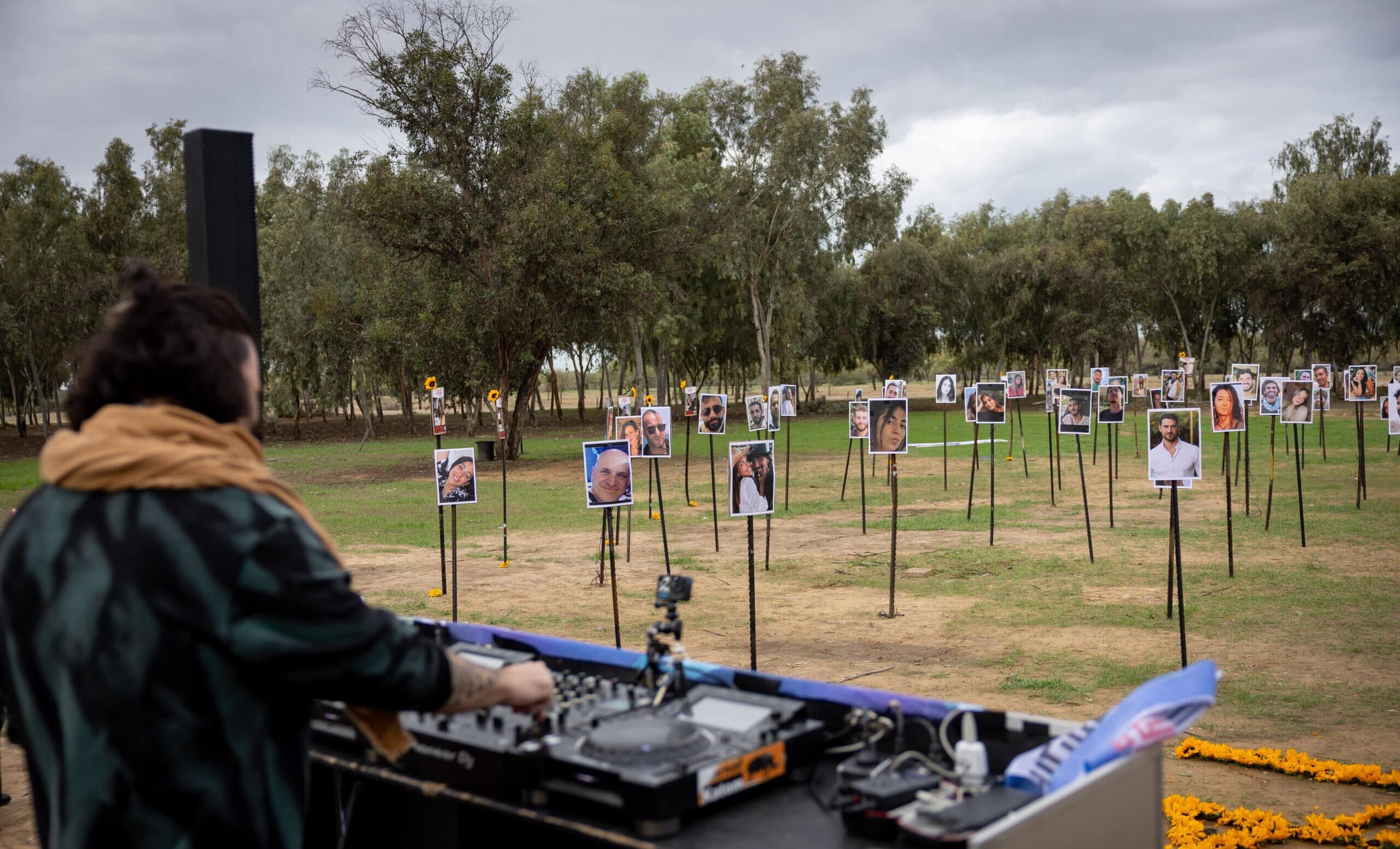
(Anmerkungen: Erstveröffentlichung in Oktober 2026, Internetzugriffe zuletzt am 19. Oktober 2026. Titelbild: We shall dance again – Pictures of the participants of the Nova party who were murdered and kidnapped by the terrorist organization Hamas on October 7, 2023 are displayed while an artist plays music, at the site of the Nova music festival massacre, in Re’im, near the Israeli-Gaza border, November 28, 2023. Photo by Yonatan Sindel. Courtesy Jüdisches Museum Frankfurt am Main.)